Grimy fiction is having something of a popular renaissance. Novels saturated in those gross, utterly human details that we fully expect literary fiction to bypass as tonally inconsistent with ‘highbrow’ literature. Yet Ottessa Moshfegh’s place at the apex of everything downright dirty shows how trends have carried us back to a place where to revel in the scatological, Joycean aspects of existence is once again mainstream. Let us not forget that Moshfegh’s writing emerges from a legacy of female writers willing to turn the stomach, delighting at our habitual discomfort and our expectation of certain censored details. Not least of these is author Katherine Dunn.
“The first problem was cat shit. The smell hit me on the sidewalk in front of Sam’s house. By the time the door opened my eyes were watering. The shit lay in thin stiff smears on the carpets. Sam had put down newspapers so that he could walk, but the cats shat on them. He put fresh papers over the soiled ones. Walking was tricky. The papers shifted and were noisy under my feet. Nobody knew how many cats there were. Nobody claimed to own them. They came with the house. There were bowls on the floor with dusty puddles of milk in them, plates with crusts of moldy cat food. After a few hours the smell didn’t hurt my nose anymore. It made me sleepy.”
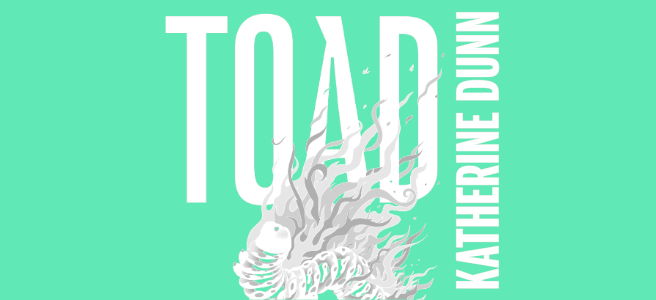
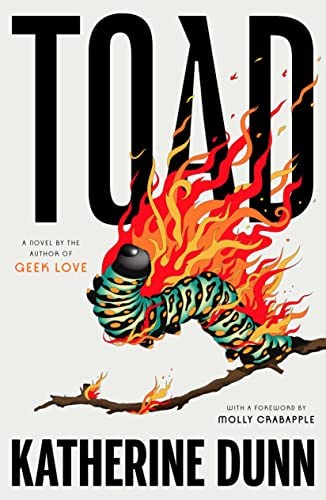
Katherine Dunn is best known as author of the 1989 cult success, Geek Love. A story of a family of circus ‘freaks’, genetically modified by the copious number of chemicals consumed by the mother during pregnancy. The Binewski family is a tornado-eye look at popular culture, desire, and identity. Raw and utterly unashamed, Geek Love drips with the disgusting and is easily one of the best novels of the 20th century. Almost as stunning as the roaring literary success of the novel was Dunn’s subsequent withdrawal from the world of published fiction. No book followed in the wake of Geek Love, that is until the posthumous 2022 publication of Toad.
Written during the 1970s, Dunn’s early efforts to get Toad published were met with rejection. It wasn’t until 2019, when an editor decided to work through the archive of Dunn’s papers at Lewis and Clark college, that the novel’s manuscript was discovered and pushed through to publication. And thank goodness it was.
Toad is a novel saturated with the 1960s hippie culture of Portland, Oregon. It thrives in the musty edges of student life, the intellectual poverty, the desperate seeking for place and connection. The novel’s narrator, Sally, is a woman plagued by insecurity. Cruel, confused, and embattled by the demons that will eventually culminate in a series of mental breakdowns. As Sally lives out her now-reclusive life, where her best kept company is the toad in her garden, our narrator reflects on her youth and, most particularly, her relationship with wayward philosopher, Sam. Sam is a fly-by-night intellectual, enamoured more with the conception of things than their physical reality. Constantly changing his name as a kind of try-on for different personas, Sam is an unflinching satire of the hypocrisies that plague young adulthood.
“It seems to me that everyone I knew in those days acted by a code chosen from books and films – or not even a code but a direct emulation of a specific character who was meant to be identified and attributed. No gesture was unselfconscious or undirected, all were modeled and formed with purpose. The alarming thing is that we were so obvious, that we all did it so badly, except Sam, who did it all too well. There was no cigarette lit, no itch scratched without a full awareness of the audience. If there was no audience, we rehearsed. If there was no prospect of an audience, we did nothing.”
Despite the specifics of its setting, Toad is no historical fiction. Perhaps travelling philosophers and communal pots of horsemeat-on-rice are a feature of student life best left in Dunn’s portrait of the 1960s. Yet the fundamentals of how newly liberated teens relate to themselves and their compatriots is largely unchanged. Honing in on the essentially human in a way that transcends circumstance, no matter how bizarre, is a skill that Dunn executes flawlessly. While Geek Love represents this at its most extreme – a family of mutated humans, circus acts, a strange body-modification cult – it remains no less effective in its incisive commentary on self-perception.
Consciously or not, Dunn’s novels ring with a desperation to understand the various iterations of our relationships to ourselves. In Sally, we observe an increasingly violent battle between the performative and authentic self. In the brief moments where she is able to fully let go, she is met with rejection. It is no surprise that, as she ages, this pattern destabilises her psychological wellbeing and leaves her determined to live a life as reclusive as possible.
“One night he had been fooling with me for a while and stumbled upon the right place, the place, and set me off. I was surprised, and then I was wild with anticipation. I cried out, this time for real; I had pretended thousands of orgasms in my time, arched by back and trembled and rattled my heels, moaned, laughed, raked my nails – all to simulate the only models I had, from literature. But at last I was undone; my orgasm was real. I gave in. I grabbed his hand to keep him from losing his place. I gripped his hair, my hips stiffened. He went on for some time and my hands slid down to keep him there. But he was insulted by my obvious enthusiasm; he must have realized I had been performing before. It disgusted him. ‘Do it yourself, then!’ he said, his bitter voice a bludgeon, and rolled away from me, furious.”
Toad is tragic but not a tragedy. No more than the grief, betrayal, and struggles of our own lives render our whole experience a tragedy. Whether in an albino hunchbacked dwarf or a student attempting to reconcile the disparate parts of herself, Katherine Dunn’s understanding of the tragic, and its frictionless existence alongside our growth, is sublimely complete. A testament to the value of Dunn’s legacy, Toad reclines in the filth and grime of life whilst reminding us that, above all, we have survived all of our worst days.

 The Book Habit